


Osteochondrosis –degenerative-dystrophic damage to the spinal tissue, characterized by damage to the intervertebral discs, adjacent articular surfaces and vertebral bodies, and spinal ligament apparatus.
Often, the pathological process in osteochondrosis first affects the bones and ligaments.We usually know that the disease has already started when complications appear - pain, sensory disturbances, muscle atrophy, dysfunction of internal organs.
Who suffers from osteochondrosis?
Nowadays, osteochondrosis affects 40 to 90% of the world's population.Most often, this disease affects people over 30 years old.However, the first symptoms of osteochondrosis may appear in adolescence.
Stages of development of osteochondrosis of the spine
- The first stage of the development of osteochondrosis.
Dehydration of the nucleus pulposus begins.This leads to a decrease in disc height.Cracks appear in the fibrous ring, but the pathological process does not extend beyond the intervertebral disc.
- The second stage of the development of osteochondrosis.
As a result of the decrease in disc height, the points of attachment of muscles and ligaments belonging to two adjacent vertebrae become closer.Therefore, muscles and ligaments relax.This can cause excessive mobility of both vertebrae relative to each other, i.e. instability of the vertebral motion segment is formed.At this stage, the slipping or displacement of the vertebrae relative to each other with the formation of spondylolisthesis is characteristic.
- The third stage of the development of osteochondrosis.
During this period, the most significant morphological changes occur, which mainly affect the intervertebral disc itself: disc prolapse and protrusion are formed.The articular apparatus of the vertebral movement segment also suffers.Subluxation occurs in intervertebral joints and unco-vertebral joints and forms arthrosis.
- The fourth stage of the development of osteochondrosis.
At this stage, adaptive changes occur in the affected spinal segment.The body tries to overcome excessive vertebral mobility and immobilize the spine to maintain its supportive and protective function.In this case, marginal bone growth appears on the adjacent surface of the vertebral body, in other words, osteophytes.Osteophytes that grow "in the wrong place" cause microtrauma to the nerve root.In the fourth stage, the process of fibrous ankylosis usually begins in the intervertebral discs and joints.Finally, the vertebral motor segment appears to be protected in the shell—clinical manifestations are reduced.
Causes of osteochondrosis
In each of the many existing theories of the development of osteochondrosis, various causes are accepted that are responsible for the occurrence of the disease, for example, mechanical trauma, hereditary predisposition or metabolic disorders.Certain difficulties in determining the cause of osteochondrosis are due to the fact that this disease can occur in both old and young people, both in well-built and poorly trained people.It is a common belief that the cause of osteochondrosis is the deposition of salt in the spine: allegedly, on X-rays, salt can be seen in the form of "growths" or "hooks" on the vertebrae.If, when moving, there is irritation and creaking in the joints, as if sand has been poured between them, for most patients, the only reason for this condition is the well-known "salt deposition".Such misunderstandings are not at all dangerous: the correct idea of how to treat a disease can be determined based on the analysis of the causes that cause it.
The term "osteochondrosis" comes from the Greek roots osteon - "bone" and chondr - "cartilage".The ending "-oz" means that bone and cartilage diseases are not associated with inflammatory processes, but are degenerative-dystrophic in nature, that is, the basis of the disease is a violation of tissue nutrition and, as a result, its structural degeneration.Like all living tissues, vertebral bone tissue and intervertebral disc cartilage tissue are constantly rebuilding and renewing themselves.Under the influence of frequent physical activity, they gain strength and elasticity, and if there is no load, the strength of the tissue decreases.
This is due to the uniqueness of nutrition and blood supply to bones and cartilage tissue.Adult discs do not have their own vessels;they receive nutrients and oxygen from neighboring tissues.Therefore, for proper nutrition of the disc, it is necessary to activate blood circulation in the tissues around the disc.And this can only be achieved through intense muscle work.
Based on its composition, the intervertebral disc can be divided into two parts: it is the nucleus pulposus, which gives elasticity to the disc, located in the center and a strong fibrous ring surrounding it.Due to the deterioration in the nutrition of the intervertebral disc, the complex structure of the biopolymer compounds that make up the nucleus pulposus is destroyed.The moisture content in the nucleus pulposus decreases and it becomes more fragile.When exposed to even small overloads, the nucleus pulposus can shatter into fragments.This leads to a decrease in its elasticity to a greater extent.There is also a decrease in the strength of the fibrous ring of the disc.All these factors create the basis and form the cause of the development of osteochondrosis.
In order to restore the function of the spine, it is necessary to scar the damage to the intervertebral disc, mobilize the compensatory ability of the spine, as well as the musculoskeletal system as a whole, and not resolve "salt deposits" or eliminate "spike" on the vertebrae.When performing an X-ray examination after the end of treatment, you can see that the vertebrae have not changed their shape.And the famous "spike" is not the cause of osteochondrosis, but the result of the adaptation process.Marginal growth increases the supporting surface area of the vertebral body.Due to the increase in area, the specific pressure decreases, which makes it possible to compensate for the decrease in strength and elasticity of the intervertebral disc.
Degenerative-dystrophic changes that occur in the spine are accompanied by calcification (calcification) of damaged discs, individual parts of articular ligaments, cartilage, and capsule.This process can only be conditionally called salt deposition.Therefore, this is not the cause of osteochondrosis, but only a consequence and the final stage of the process described above.
Reversal of structural changes in the spine is almost impossible.But minimizing them is a very real task.If no effort is made to maintain the spine in the same condition as achieved as a result of treatment, the pain may recur.
Clinical manifestations of osteochondrosis
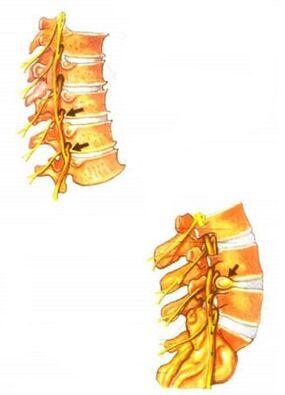
Clinical manifestations of osteochondrosis are very diverse.They depend on the stage of development of osteochondrosis.The main clinical symptoms of osteochondrosis occur when the pathological process spreads to the back of the fibrous ring and the posterior longitudinal ligament.Depending on the stage of intervertebral disc degeneration, irritation, compression or conduction disturbances of the spinal cord root, compression of blood vessels or spinal cord occurs.Various neurological syndromes develop - reflex and compression.
The main cause of pain in osteochondrosis is irritation of the so-called nerve roots.In this case, circulatory disorders occur, swelling occurs, and fibrosis of the surrounding structure may then develop, which is accompanied by increased sensitivity of the root to various influences (movement in the affected spinal segment, etc.).
Vascular disorders in osteochondrosis are often associated with impaired vasomotor conservation.Mechanical compression of blood vessels by osteophytes is also possible, for example in the cervical spine.
Symptoms of osteochondrosis
One of the features of osteochondrosis of the spine that worsens the process is that the symptoms are too broad.This disease can manifest itself in completely different parts of the body.This may be pain or numbness in the limbs or disturbances and pain in the internal organs.At the same time, often a person does not in any way associate pain in the heart, dysfunction of the genital organs, headaches, pain and numbness in the legs with osteochondrosis and in general with the spine, directly "treating" the symptoms of osteochondrosis with the help of various types of painkillers, all types of advertised drugs, food supplements and others.But this path only worsens the situation.Osteochondrosis continues to develop, and the treatment methods used, at best, only do not lead to significant improvement, other than temporary pain relief, and in the worst case, they can harm the body even more.
Therefore, it is important to carefully analyze your situation and the changes that occur in it.It is necessary to start moving in the right direction: consult a doctor on time, undergo the necessary diagnostics, and only after determining the correct diagnosis begin treatment under the supervision of the attending physician.
The main symptoms of osteochondrosis include, first of all, pain and discomfort in the back.At the same time, pain can be periodic, inconsistent, appear and disappear.But the first feeling of discomfort or pain in the spine should make you think.The first appearance of pain is a signal to at least pay attention to this and try to remember the reason why it appeared.Such reasons can be lifting heavy objects, sudden movements, falls, etc.
Another symptom of osteochondrosis is the accompanying discomfort or pain in the back with pain and numbness in the legs (arms or legs).The pain most often radiates to the left limb, that is, to the left arm or leg.In addition, pain can manifest in the heart area, in the back, and not only in the spinal area, but, for example, in the ribs, etc. It is very important in this case to pay attention to the nature of changes in pain depending on the patient's actions, comparing the sensation of pain in the back with pain, for example, in the legs.If the patient sits for a long time and has pain or numbness in the legs, discomfort in the lower back, and after warming up or a short walk the pain disappears, then this will be an indirect sign that determines lumbar osteochondrosis of the spine.The same picture can be with the neck and arms.To summarize, we can say that the main symptoms of osteochondrosis include pain and discomfort in the back.In cases where these symptoms coincide with pain in other parts of the body, osteochondrosis can be complicated by protrusion, disc herniation, or pinched nerves.
In addition, I would like to draw attention to the fact that even if the first pain in the spine appears, it is necessary to pay special attention to this disease.After all, osteochondrosis may show itself weakly or not at all for quite some time.At the same time, it will continue to grow successfully in the spine, leading to the degeneration of an increasing number of discs.Therefore, a timely visit to the doctor will allow osteochondrosis to be diagnosed at an early stage, which will facilitate its treatment.
Osteochondrosis and salt deposition
Osteophytes or hook-shaped vertebral growths appear to reduce the load on the intervertebral disc.In this case, the appearance of osteophytes impairs the mobility of the intervertebral joints.
The widespread belief in everyday life that salt deposition is the main cause of osteochondrosis is wrong.Therefore, the treatment of osteochondrosis using a salt-free diet is useless.
The most common complaint with osteochondrosis of the spine
The most common complaints with osteochondrosis are as follows:
- Discomfort in various parts of the spine.The pain can vary from a small ache, dull, annoying to severe, sometimes very intense and unbearable - with shooting.
- Increase fatigue during work, both physical and mental.
- Loss of sensitivity in limbs and various parts of the body, cold hands or feet.
- Pain radiates to the leg, along the nerve trunk.
- Pain radiates to the shoulder blade, shoulder, and pain in the neck and back of the head.
- Frequent companions for cervical osteochondrosis are headaches and dizziness.Increased visual fatigue or decreased visual acuity is often observed.
- When the lumbosacral area is affected, disorders of the reproductive system - various sexual dysfunctions - are common.Therefore, most men experience an increase in sexual power after treatment.In women, the normal function of the lumbosacral region increases the possibility of conception and contributes to a comfortable pregnancy.
Diagnosis of osteochondrosis
To diagnose osteochondrosis, it is necessary to collect anamnesis.Determining patient complaints is very important.Certain symptoms of osteochondrosis are quite characteristic.Others, on the other hand, must be distinguished from the signs of other diseases.It is important that the nervous, vascular, and trophic disorders that occur in osteochondrosis can imitate various diseases, such as angina pectoris, gastritis, gastric ulcers, and acute surgical diseases of the abdominal organs.Therefore, to avoid misdiagnosis and incorrect treatment prescription, each symptom must be subjected to a detailed analysis.
When collecting the anamnesis, including the patient's complaints, the history of current diseases and the patient's life, the doctor pays attention to his age, because osteochondrosis most often develops in the elderly, and to the evolution of symptoms from the moment they arise until the patient consults a doctor.Osteochondrosis is characterized by a slow progression, in which periods of exacerbation are periodically replaced by periods of remission.Additional research methods are prescribed to clarify the diagnosis.
X-ray study for osteochondrosis
The most accessible method for diagnosing osteochondrosis, and at the same time quite informative, is an x-ray examination.There are several types of x-ray methods to diagnose this disease:
Radiographic examination of the spine is the easiest radiological method to diagnose osteochondrosis.The essence is to get an x-ray on the spine as a whole or its individual segments.Often, targeted radiography is performed - based on the symptoms of the disease and the patient's complaints, the location of the spinal lesion is determined.On the x-ray image of the spinal segment affected by osteochondrosis, one can see a decrease in the thickness (atrophy) of the intervertebral disc, which is shown in the form of a reduction of the space between the vertebrae, the appearance of bone growth of the vertebral body - osteophytes, partial dissolution - absorption in the spinal tissue, examples of changes in the shape of the spinal column.smoothing lumbar lordosis.
Myelography is a more complex and dangerous diagnostic method.During such an examination, a certain amount of contrast liquid is injected into the spinal canal.The risk of this examination method is the possibility of an allergic reaction to the contrast agent or the risk of damage to the spinal cord during spinal canal puncture.Myelography can determine the internal structure of the spinal canal.This method is very informative to determine spinal hernia.
Computed tomography and nuclear magnetic resonance are the most modern methods, but also the most expensive and difficult to access to diagnose osteochondrosis.This diagnostic method is usually used when it is necessary to distinguish between osteochondrosis and other diseases of the spine with similar symptoms, for example, tumors of the spinal canal.
For a comprehensive assessment of the patient's condition, it is mandatory to conduct a neurological examination of the patient with osteochondrosis.Thanks to the neurological consultation, it is possible to clarify the location and degree of motor and sensory disturbances.
Treatment of osteochondrosis
This clinic provides effective treatment for all forms of osteochondrosis.Treatment is carried out on an outpatient basis.The treatment is based on a comprehensive program aimed at quickly eliminating the underlying syndrome and the cause of suffering.The following methods can be used as part of complex therapy:
- acupuncture;
- vacuum therapy;
- gentle manual therapy techniques (post-isometric relaxation);
- laser therapy;
- pharmacopuncture;
- dry traction;
- magnetopuncture;
- electrical stimulation and other treatment methods.
On average, the course of treatment is 10-15 sessions, and the elimination of acute pain syndrome is from 1 to 3 sessions.
The sooner treatment is started, the better the results!
Is complete relief from osteochondrosis true?
It depends on the form of the disease, severity, accuracy and timeliness of treatment.Complete healing is possible only in the early stages.
But you can avoid aggravation of osteochondrosis and not feel pain for many years.If a person has osteochondrosis, but now he does not experience discomfort, this does not mean that it has passed without a trace.There may be changes in the spine.
The main task is to stop the progression of the disease and do everything possible to ensure that some pathological changes in the spine disappear, symptoms disappear or decrease (back pain, coldness and numbness of arms, legs, headaches, etc.).